

Learn
Why We Care About Tech
Tech in schools is rolling out faster than we can understand its effects. 1:1 devices, AI tools, adaptive apps, and digital testing are now standard in most districts — but few parents have seen the research that shows what these tools actually do to how kids learn, what they do to their bodies and sleep, and what happens to their data.
When parents ask questions, they often get met with "it's the future" or "everyone's doing it." That's not good enough. Your child deserves intentional decisions based on evidence, not convenience.
What the Research Shows
It seems that every week, new studies come out on how screens affect learning, sleep, eyesight, and attention. Rather than duplicate that work, we're grateful to fellow parent advocacy group, Pencils Over Pixels, for their comprehensive research pages — which we're summarizing and linking to here.
If you want to go deeper on any of these topics, we highly recommend their site as a place to start.
-
Across 30 neuroimaging studies spanning three decades, handwriting activates an integrated network of 9 or more brain regions simultaneously, while typing recruits only 2 to 3 regions. The difference matters most in early reading.
Pre-literate children who learn letters by handwriting develop activation in the fusiform gyrus, posterior parietal cortex, and inferior frontal gyrus during letter viewing — the same adult reading network active in skilled readers. Children who learn the same letters by typing or tracing show no such activation. This neural connection is foundational.
At 3-month follow-up, children who learned letters by handwriting retained the advantage, while the typing group's initial edge had disappeared entirely. The implication for K-2 instruction is direct: hours spent on typing-based or touchscreen activities may displace the handwriting practice that builds reading networks.
-
The physical effects of extended device use accumulate quietly but measurably.
Eyes:
Two hours of daily outdoor time shows a significant protective effect against myopia, likely through retinal dopamine release that inhibits eye growth.Neck and Spine:
A forward head tilt of 60 degrees, typical when looking down at a phone or laptop, places approximately 60 pounds of force on the cervical spine, compared to roughly 12 pounds when upright. Children's head-to-body ratios are larger than adults', meaning the same posture may load their spines proportionally more.Sleep:
Ninety percent of studies on screen time and sleep found adverse associations, primarily shortened sleep duration and delayed bedtime. Evening blue-light exposure from screens suppresses melatonin production, delaying the body's sleep signal. Sleep loss, in turn, is one of the strongest known risk factors for adolescent anxiety and depression. -
What About Students Who Learn Differently?
The research on handwriting, screens, and cognition has particular relevance for neurodivergent learners and students with learning disabilities. If you're navigating 1:1 devices or AI tools as a parent of a child with an IEP or 504 plan, these pages are essential:
What’s Happening at SPS
Student screen time and tech usage varies by teacher, grade, and school. Talk to your child’s teacher to learn what’s actually happening in their classroom.
-
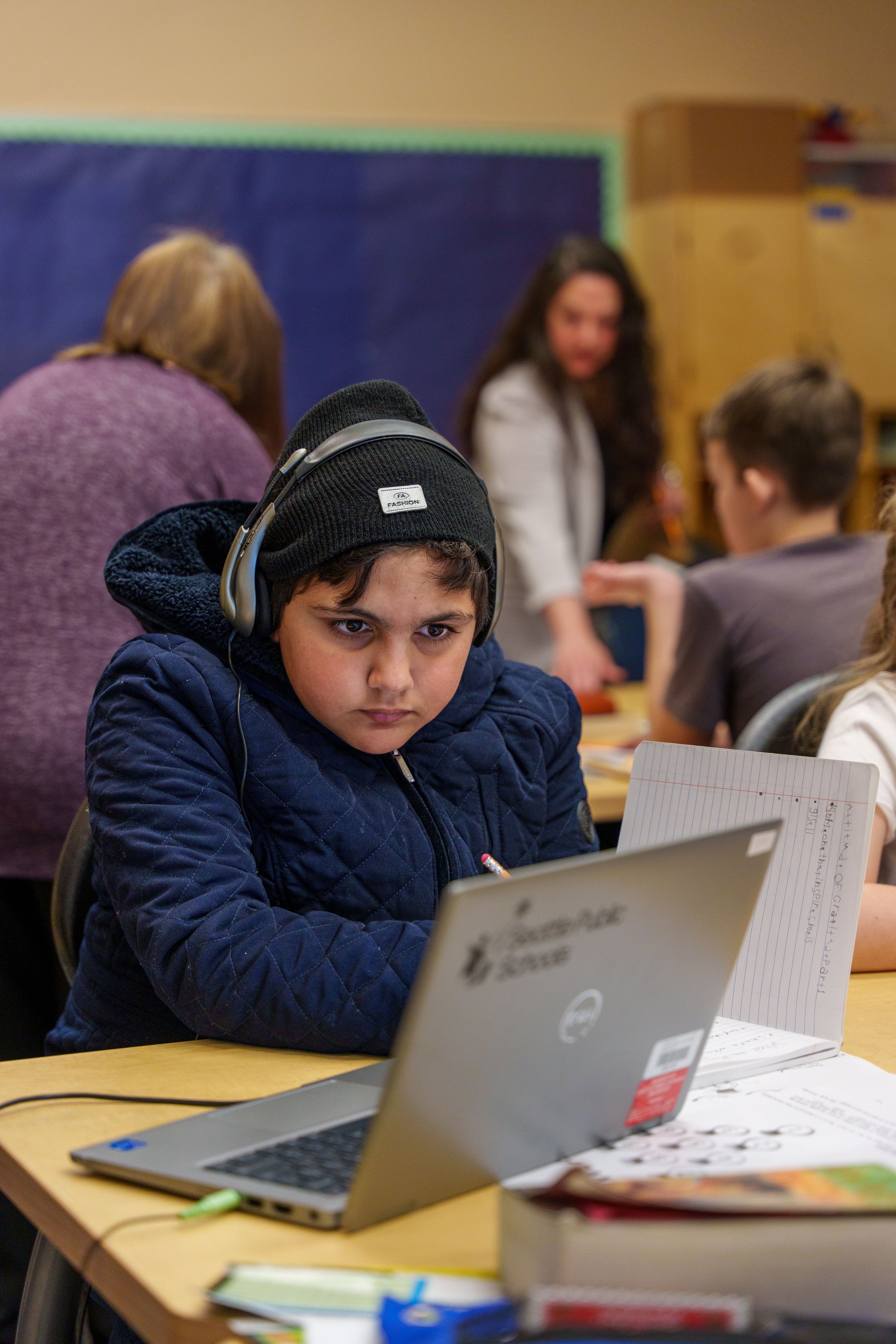
The district assigns iPads to K–2 students, and laptops for 3-12.
At the July 8 board meeting, the board approved BEX VI levy funding for new student devices covering 2027–2029:
$73,118,479 includes 22,652 laptops for 3-8 and 14,997 for high school (board link)
$6,000,000 includes 14,000 iPads for K-2 (board link)
Directors and the Superintendent left open whether approving the contracts commits the district to spending the full amount, so family input still matters.
-
In August, the district released SAIL (Seattle AI Literacy) guidance for teachers, which recommends an introduction to AI in kindergarten, and usage starting in 3rd grade.
New York banned generative AI through middle school, while LAUSD implemented a one-year moratorium for all grades.
Seattle is currently moving forward with guidance, but without adequate support or training for teachers.
-
Schools use a range of tools, from academic (IXL, Envision, Sushi Monster) to free-time and brain breaks (Danny Go YouTube, online games). Screen time varies significantly by teacher and grade.
-
All standardized testing K-12 is conducted on devices. This means that teachers need to prepare students how to use devices to prepare them to complete testing.
Paper test options are available. According to Washington State law, students whose IEP or 504 plan states paper may request paper tests.
-
SPS introduced a new cell phone procedure at the end of the 2025/2026 school year.
K-8: Away for the Day (phones not accessible during school hours)
9-12: No Cell Bell to Bell (limited access during lunch and passing periods)
Washington State is proposing an “Away for the Day” policy for K-12 statewide for September 2027.
-
Policy 3540: Student Internet Access
Policy 2023: Digital Citizenship & Media Literacy
Policy 3232: Parent/Guardian & Student Rights in Data Collection
Resources
Books & Blogs
Coding Kids: Big Tech’s Battle to Remake Public Schools, by Natasha Singer. How Big Tech captured computer science and AI education in America.
The Digital Delusion: How Classroom Tech is Harming Student Learning and What We Should Do About It by Jared Cooney Horvath. Accessible overview of what the research actually shows about ed tech and student outcomes.
The Anxious Generation: How the Great Rewiring of Childhood is Causing an Epidemic of Mental Illness by Jonathan Haidt. Explores how phones and social media are affecting child development and mental health.
First Fish: Dismantling EdTech by Emily Cherkin. Practical guide from a parent and educator perspective.
Go Away and Let them Play by Elizabeth Hunter. Tips from a local parent advocate encouraging childhood independence.
Articles & Interviews
The Digital Delusion: How EdTech Harms Our Kids' Learning, interview with Jared Covey Horvath by Emily Cherkin
The Screen That Ate Your Child’s Education, by Jean M. Twenge, The New York Times
What We Lost When Big Tech Took Over the Classroom, by Jessica Winter, The New Yorker
The U.S. spent $30 billion to ditch textbooks for laptops and tablets: The result is the first generation less cognitively capable than their parents, Fortune, February 2026
Podcasts & Media
The Movement is Growing
These kids are learning without technology in Seattle Public Schools, The Seattle Times, August 2026
Los Angeles becomes the first major school district to require screen time limits, NBC News, April 2026
iPads in Kindergarten, YouTube on Breaks: The School Screen-Time Battle, The New York Times, March 2026
Parents are opting kids out of school laptops, returning them to pen and paper, NBC News, February 2026
SPS Information
The Bulletin (regular SPS updates)
Network Use Agreement for upper grades
SFIT Petition to SPS School Board, presented April 22, 2026
Orgs & Initiatives
Distraction-Free Schools Policy Project: Working on state and district policy changes
Schools Beyond Screens: LA parent-led coalition
The Balance Project: Building evidence-based tech policy
Let Grow Play Club: Adult-free, screen-free play for kids
Smartphone Free Childhood: Resources for reducing phone use
Screen Strong: curriculum and resources for teaching kids about screens and brains
EdTech Law Center: Legal resources and student data protection
Lanier Law Firm: social media addiction law & statistics
The Tech Edvocate: protecting student data
Many of the templates, letters, and organizational resources on this page come from Emily Cherkin, educators and parents in SPS, other edtech advocacy sites like Pencils Over Pixels, and national organizations like Schools Beyond Screens and Distraction-Free Schools to name a few.
We're grateful for their work and their generosity in sharing resources.